I can tell teachers to be creative, but teachers need more than just a principal or district initiative telling them to do this. That is the challenge I took away from the book, Leadership for Deeper Learning by Jayson W. Richardson, Justin Bathon, and Scott McLeod (2021). As a former teacher and technology integration specialist, now an elementary principal studying Creativity and Change Leadership, the biggest takeaway was the understanding that creativity is a responsibility of the whole school and that we need to analyze the needs of every child to bring on this creative change.
The authors investigated leadership in 30 innovative schools through interviews and visits to the schools.
Five domains organize this book:
● Vision
● Student learning
● Professional capacity
● Organizational support
● External partnerships
The continuous message is alignment: meaningful student work depends on teacher expertise, trust, and supportive school structures.
One of the schools discussed in the book was EPiC Elementary. An example from this school explained that children applied force-and-motion standards to toy prototypes tested with kindergartners (p. 58). That example brings together academic content, purposeful design, and a real audience. If you are in the field of education, you know the importance of these elements.
My biggest shift was connecting this to equity. The authors describe leaders driven by who is being underserved and what must change (pp. 157–158). I want to expand opportunities for students ready for greater challenge. This book pushes me to ask that question about every learner: who gets meaningful work, who gets a voice, and who spends the day completing tasks someone else designed?
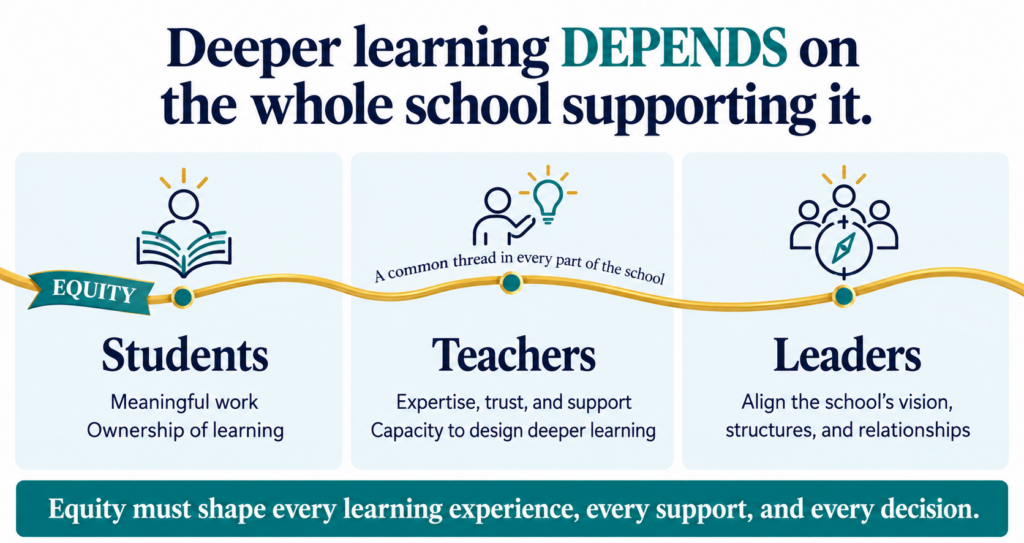
Below is a graphic that I designed (with a little help from AI), explaining the role that each player has in making real creative change in a school. Notice that the common thread is equity. Many of the examples in the book referred to pockets of students in a school or decisions made my groups of teachers. If we want real school-level change, we must think in terms of equity and how the voices and needs of all teachers and students are being met, listened to, and used to make creative change.
Being in education for almost 20 years, I truly felt this line: “we cannot simply write a check and purchase school innovation” (p. 103). Educators need to stop looking for the next best product or program thinking this will lead to innovation. I’m leaving the book more interested in students’ decisions and thinking than in whether an activity looks innovative. Tools matter, but student voice and decisions in their learning means much more.
In my school, I started a Progress Consortium to solve challenges and to improve practices in the building. My Progress Consortium brings staff together using Creative Problem Solving (clarifying, ideating, developing, and implementing). The book raises my expectations for what follows those conversations: shared ownership, protected time to test ideas, and feedback about what students experience. A productive meeting is only a beginning for all of us, but especially for me as a leader. The work is incomplete if an idea leaves the meeting without support or a chance to learn from trying it. And, to weave in the title of this Blog post, Deeper Learning DEPENDS on the Support of the Whole School. It takes all of us to push the mere ideas into actionable work with our students, while ensuring that all students are benefiting from the work.
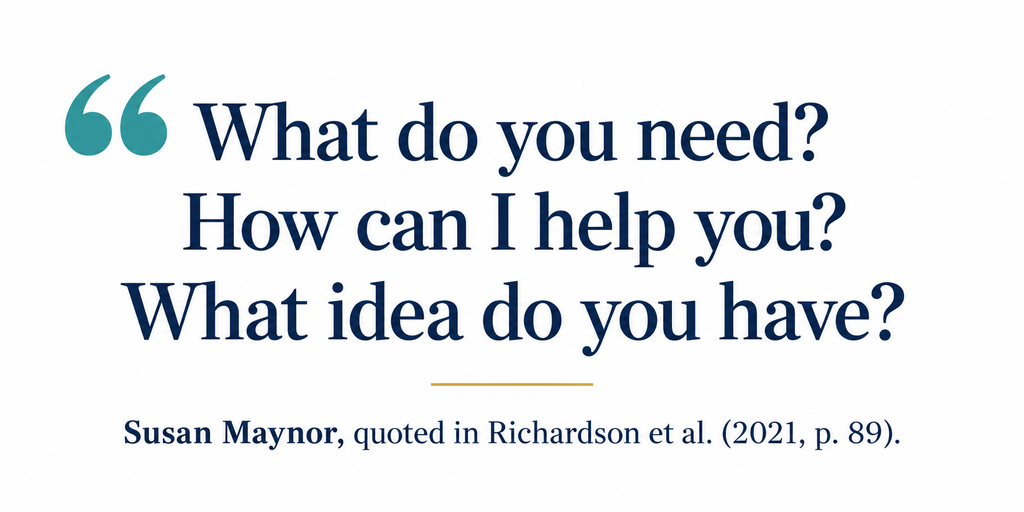
Susan Maynor’s questions (Richardson et al., 2021, p. 89) capture the approach I want to strengthen in my building. I connect that approach to Edmondson’s (1999) finding that psychological safety was associated with learning behavior in 51 manufacturing teams. Although that study was not conducted in schools, it gives me a starting place: how I respond to an unfinished idea that we come up with in our Progress Consortium may influence whether teachers bring me the next one.
I agree with the authors that teachers need trust and support to design meaningful learning. Their examples are useful and encouraging, but unfortunately they cannot prove which practices caused better outcomes. The authors selected innovators and schools where there was known “innovation” and acknowledge that their sample is not representative of what public schools look like today (p. 159). I also wanted more about what schools stopped doing to make room for change. As a principal, I need to understand the tradeoffs.
Many innovative projects were described, but I don’t believe that we can equate individual projects with creative growth for an entire school. I want evidence of students generating, evaluating, and improving ideas. The examples show what is possible rather than the measurement of creativity. For a creative audience, that difference matters: changing an assignment’s format does not necessarily change the thinking it requires. This is certainly an area that we will continue to explore.
In my own work, I want to protect time for teachers to examine student work together and identify the support they need. I also want to hear from students whose experiences are easiest to overlook. Equity becomes more meaningful when those voices influence what we change. I also understand that much of the work described in this book was from the high school lens. The work at an elementary school may look very different. Can we weave in the voices and specific needs of the youngest learners to ensure equity? Of course. But, at the primary level, the work of educators is to be the voice for those who may not be able to articulate their needs.
My takeaways are to: protect teacher learning, share meaningful decisions, and examine who benefits from change to ensure complete equity in the decisions we are making.
References
Edmondson, A. (1999). Psychological safety and learning behavior in work teams. Administrative Science Quarterly, 44(2), 350–383. https://doi.org/10.2307/2666999
Richardson, J. W., Bathon, J., & McLeod, S. (2021). Leadership for deeper learning: Facilitating school innovation and transformation. Routledge.
Leave a Reply